Thank you! Your submission has been received!
Oops! Something went wrong while submitting the form.

A job description is a structured document that defines the purpose, duties, responsibilities and requirements of a role. Well-written job descriptions are the foundation of consistent job evaluation, fair compensation, effective recruitment and clear performance expectations.
Most job descriptions follow a standard structure, though the level of detail varies by organisation and role type.
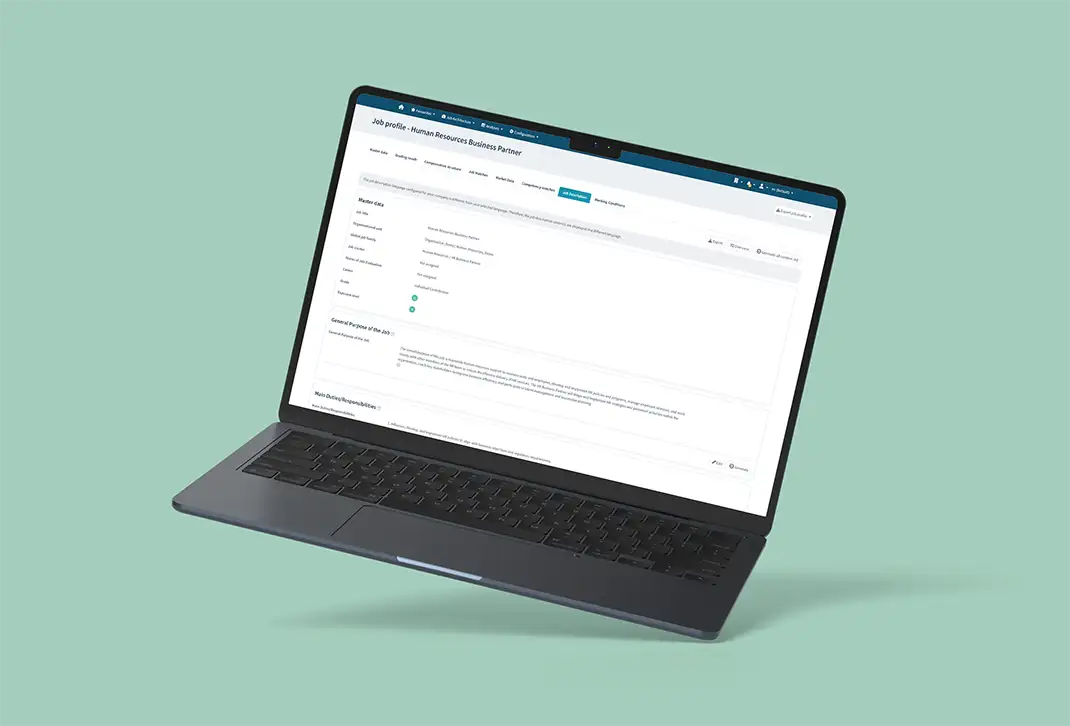
Basic details that place the role within the organisation:
Job title
Department / business unit
Location
Grade / job level
Reporting line
Direct reports (if applicable)
A concise statement - typically two to four sentences - describing why the role exists and its primary contribution to the organisation.
The main activities the role performs, typically grouped by theme and written using active verbs:
Develops and maintains…
Oversees and coordinates…
Analyses and reports on…
Duties should reflect what the role actually does, not what the ideal outcome looks like.
Quantitative context that helps calibrate the size and impact of the role:
Budget managed
Team size
Revenue or portfolio responsibility
Geographic coverage
A distinction is commonly made between:
Essential - qualifications, experience or skills the role cannot function without
Desirable - attributes that add value but are not mandatory
Requirements typically cover education, years of relevant experience, technical skills and behavioural competencies.
Practical information about how and where the role operates, including location type, travel requirements and shift patterns where relevant.
These terms are sometimes used interchangeably but describe distinct documents. A job description focuses on the role - its duties, reporting lines and organisational context. A job specification focuses on the person - the skills, qualifications and competencies required to perform the role effectively. In practice, many organisations combine both into a single document, variously called a job profile, role profile or position description.
For job evaluation to be consistent and defensible, it must be grounded in accurate, up-to-date job descriptions. A role is evaluated on what it requires - not on the individual currently in the role, their tenure or their personal performance.
Common inputs from a job description into an evaluation framework include:
Complexity of decisions required
Level of knowledge and expertise needed
Degree of autonomy and accountability
Scope of people, financial or operational responsibility
Nature of internal and external relationships
As pay transparency requirements increase - including under the EU Pay Transparency Directive - consistent role documentation becomes increasingly important. Job descriptions support transparency by:
Providing a documented basis for grade and level decisions
Enabling like-for-like role comparisons across functions and geographies
Supporting the communication of pay differences based on role scope and responsibility
Creating an auditable record of how roles are defined and evaluated
Organisations with inconsistent or outdated job descriptions are more exposed when required to explain or justify pay structures.
Job descriptions vary significantly in format across organisations and sectors:
prose-based, describing the role in flowing text
uses clearly labelled sections and bullet points
organises responsibilities around competency frameworks
structured to directly feed job evaluation inputs
No single format is universally correct. The most important factor is internal consistency - all job descriptions within an organisation should follow the same structure and level of detail.
Job descriptions should be reviewed whenever a role changes materially, not only during recruitment. Common triggers for review include:
Restructuring or changes in reporting lines
Significant shifts in scope or responsibility
Introduction of new technology or processes
Regrading requests or pay equity audits
Outdated job descriptions undermine job evaluation, benchmarking and pay transparency - making regular review an operational as well as a compliance consideration.
A well-designed job description is only as useful as the process behind it. Without a consistent approach to how job descriptions are created, reviewed and maintained, organisations quickly end up with documents that vary in quality, format and accuracy across teams.
A practical process typically covers four areas:
Decide who is responsible for creating, approving and maintaining job descriptions. HR typically owns the framework and templates; line managers provide role-specific content; senior leaders or HR business partners sign off. Where works councils or employee representatives are involved, their role in the process should be defined upfront.
All job descriptions should follow the same structure and use consistent terminology. This makes roles comparable across the organisation and simplifies both job evaluation and pay transparency reporting. Templates should be reviewed periodically to ensure they remain aligned with the organisation's job architecture.
Job descriptions should not be reviewed only at recruitment. Define the events that trigger a review - restructuring, changes in reporting lines, significant shifts in scope, regrading requests or pay equity audits - and make these part of standard HR workflows.
No single format is universally correct. The most important factor is internal consistency - all job descriptions within an organisation should follow the same structure and level of detail.

A job description focuses on the role - its duties, reporting lines and organisational context. A job specification focuses on the person - the skills, qualifications and competencies required to perform the role. In practice, many organisations combine both into a single document called a job profile or role profile.
There is no universal standard, but most effective job descriptions are concise enough to be read quickly and specific enough to be useful. Two to three pages is a common range for professional roles. The priority is consistency - all job descriptions in the organisation should follow the same level of detail.
Typically a collaboration between HR and the relevant line manager. HR provides the template, framework and quality control; the line manager provides knowledge of what the role actually does. The job description should reflect the role as it is designed, not as the current incumbent happens to perform it.
At minimum, whenever a role changes materially - through restructuring, a change in reporting lines, a significant shift in scope or a regrading request. Many organisations also conduct a periodic review of all job descriptions every two to three years to ensure alignment with the current job architecture.
Yes - and increasingly they need to be. Under frameworks such as the EU Pay Transparency Directive, organisations must be able to demonstrate that pay differences are based on objective, documented role requirements. Consistent job descriptions provide the evidential foundation for that. Organisations with inconsistent or outdated documentation are more exposed when required to explain or justify pay structures.
Job evaluation assesses the requirements of a role - not the person in it. Accurate, up-to-date job descriptions are the primary input into that process. A job description that is vague, inflated or out of date will produce an unreliable evaluation result. The two need to be maintained together.
Yes. gradar uses the information already captured in your job evaluation and job architecture - job level, role scope and evaluated factors - to generate clear, professional job descriptions using AI. Because they are built from evaluated job data, they remain consistent across roles and aligned with your job architecture. They can be reviewed, edited and exported, and regenerated when roles change.
Yes. Job descriptions can be generated in the language selected by the user, making it straightforward to produce role documentation suitable for different countries or regions.
Yes. Job descriptions can be exported as Word documents and used within your HRIS, applicant tracking system or internal job catalogue.
Job titles, job families, career paths & competency profiles - the building blocks of a clear job architecture

Define grades, career paths & job families for a fair, transparent organization.