Thank you! Your submission has been received!
Oops! Something went wrong while submitting the form.

Professional career paths and career ladders are key instruments of modern personnel development. They enable organisations to distribute tasks and responsibilities more effectively and to create development opportunities beyond traditional management roles.
Also referred to as career ladders or career lattices, professional career paths provide an alternative to management careers. They allow technical and process responsibility to be systematically transferred from managers to specialists.
Ideally:
Executives focus on disciplinary and organisational leadership
Professionals contribute primarily through technical expertise and skill development
In practice, however, managers are often treated as the “top experts” and continue to perform technical tasks — which can undermine effective leadership.
The success of introducing a professional career path depends heavily on:
Existing organisational practices
Willingness of leaders and employees to change
Cultural readiness to decouple expertise from formal authority
In highly hierarchical organisations, this transition is often more difficult and disruptive.
Management responsibility is frequently associated with visible status changes, such as:
Changes in job title
Private offices
Premium devices (smartphones, tablets, laptops)
Shift from non-exempt to exempt compensation plans
Target bonuses
Company cars or increased car allowances
Additional benefits (e.g. insurance or medical check-ups)
These symbols act as insignia of power, reinforcing the idea that leadership roles are inherently more valuable than expert roles.
A professional career path can only be considered equivalent to a management career if:
Senior expert roles receive the same or equivalent benefits
Status symbols are linked to job value, not hierarchical position
Traditional symbols are replaced with more egalitarian organisational practices
A modern job evaluation system (such as gradar) is used to evaluate all careers consistently
While power dynamics exist in every organisation, specialist career paths can help distribute responsibility more evenly and reduce the risk of power concentration.
In this example, the Vice President of Human Resources holds overall responsibility for the HR function, focusing on strategic leadership and people management.
Operational and technical responsibilities are delegated as follows:
Directors lead operational teams and specialised experts
Senior experts act as product owners for HR sub-disciplines
HR Scrum Masters facilitate sprints and ensure information flow
Interdisciplinary development teams design, evaluate and implement processes and products
Participation in sprints is open to all employees, subject to operational requirements.
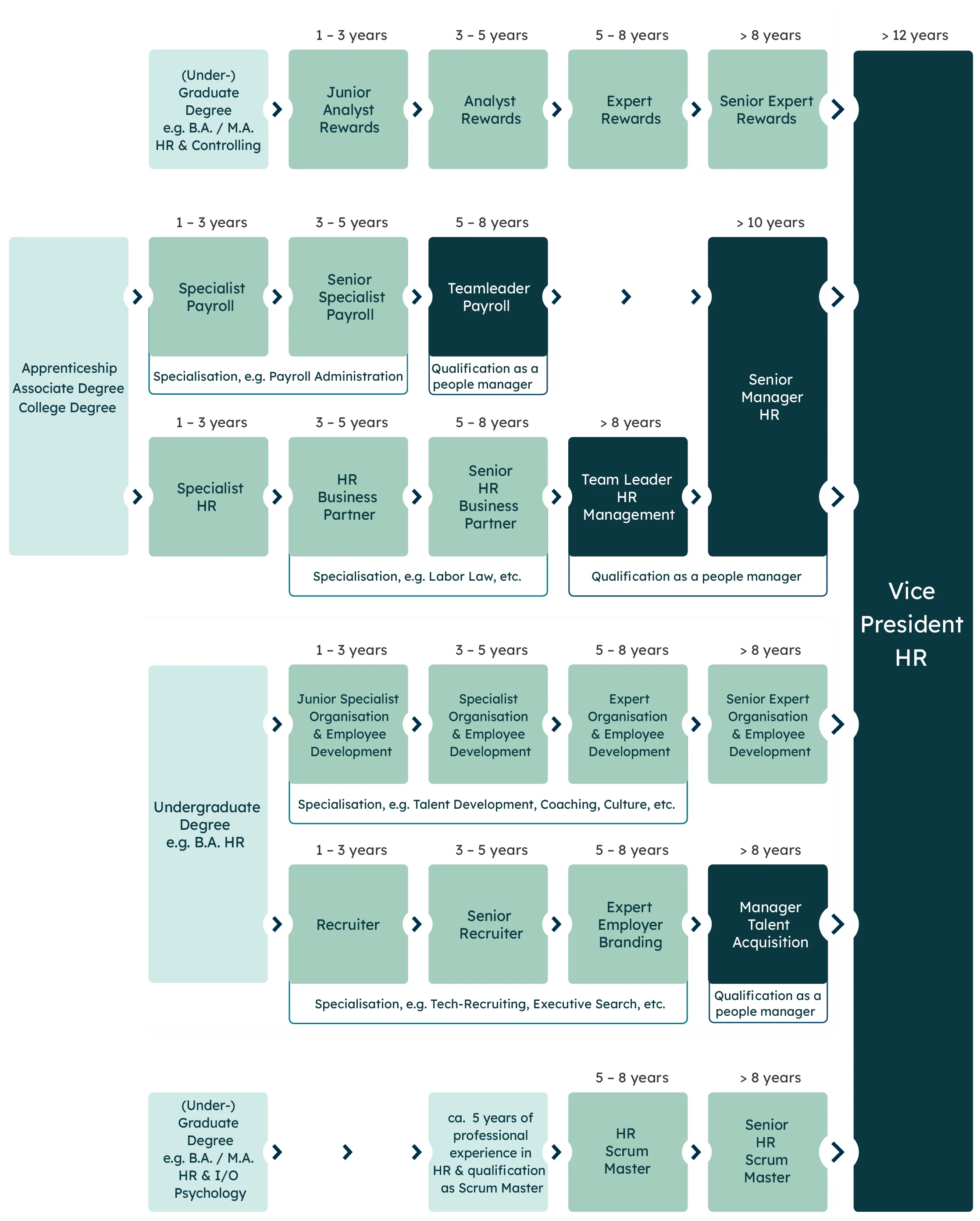
Career path frameworks illustrate progression options but do not define detailed tasks or job values. These are documented separately through job evaluation and cross-comparison tools.
Successful implementation requires:
Equivalence between professional and management career paths
Experts leading technical domains
Managers who are capable and willing to lead people
Project managers with responsibility for budgets and delivery
Individual Contributors empowered to develop and implement processes and products
Clear communication to make expert roles visible
Scrum Masters to support agile environments and role clarity
From an organisational theory perspective, jobs are evaluated across three dimensions:
Input – knowledge, skills, qualifications and experience
Throughput – influence on processes and procedures
Output – results produced or owned by the role
A fourth dimension has gained importance in modern organisations:
Communication and social interaction
This reflects changes in the world of work, including automation, digitisation and the growth of service-based roles.
As work evolves, leadership shifts from issuing instructions to:
Motivating teams
Communicating effectively
Resolving conflicts
Coordinating across functions
Job evaluation systems must reflect these realities.
To meet modern expectations around fairness, non-discrimination and transparency, gradar’s job evaluation framework incorporates all four dimensions.
This allows:
Comprehensive assessment of job value
Avoidance of double counting
Fair comparison across career paths
Factor Coverage
Input: Expertise, experience
Throughput: Problem solving, functional responsibility (IC), project leadership (PM), leadership span (MM), process influence
Output: Organisational, functional or project responsibility
Organisational Knowledge: Reflects modern, flat and agile organisational structures
This approach is influenced by the work of Prof. McFarlane (Stanford University), which recognises both formal and informal organisational structures.
Job titles, job families, career paths & competency profiles - the building blocks of a clear job architecture

Define grades, career paths & job families for a fair, transparent organization.

Lorem ipsum dolor sit amet, consectetur adipiscing elit. Suspendisse varius enim in eros elementum tristique. Duis cursus, mi quis viverra ornare, eros dolor interdum nulla, ut commodo diam libero vitae erat. Aenean faucibus nibh et justo cursus id rutrum lorem imperdiet. Nunc ut sem vitae risus tristique posuere.