Thank you! Your submission has been received!
Oops! Something went wrong while submitting the form.

Job evaluation is the systematic process of determining the relative value of roles within an organisation - based on their requirements, not the people who hold them. It is the structural foundation of fair, consistent compensation. Without it, pay decisions are subjective, inconsistent, and difficult to defend - legally or internally.
This page gives you an independent overview of the four main job evaluation methods: how they work, where they are used, and what to consider when choosing an approach.

Job evaluation defines the internal value of a role within an organisation. It answers one question: how does this job compare to others in terms of its requirements?
Job evaluation assesses the job - not the person holding it, not their performance, and not the company’s revenue or size.
A job evaluation result - typically a grade or level - is not a salary. It is a structured input into compensation decisions. Organisations use it to:
Build consistent, transparent pay structures
Design meaningful career paths and job architectures
Demonstrate equal pay for work of equal value
Support compliance with pay transparency legislation
Match internal roles to external salary benchmarks
Provide clear, auditable criteria for promotion decisions
Integrate HR processes - from recruitment to workforce planning
Job evaluation emerged in the early 20th century as organisations sought a systematic way to determine fair wages. Early systems were designed for industrial production environments and focused heavily on physical labour, task complexity, and working conditions.
Over the following decades, two broad approaches emerged: analytical and non-analytical. Analytical systems assess jobs against defined criteria and produce objective, documented results. Non-analytical systems rely on comparison or classification without structured scoring.
By the late 20th century, the shift from task-based to knowledge-based work - and the growing importance of equal pay legislation - made analytical, requirements-based evaluation the standard for professional HR practice.
Today, job evaluation is no longer just about wage determination. It is the structural backbone of job architecture, career development, compensation transparency, and organisational design. The EU Pay Transparency Directive, which requires organisations to use gender-neutral, analytical job evaluation criteria, has brought renewed attention to the choice of method.
The most important distinction in job evaluation is between analytical and non-analytical methods. This distinction matters not just methodologically, but legally.
Objective and consistent across all roles and job families
Documented and auditable - every decision can be traced and explained
Defensible in equal pay disputes and legal proceedings
Required for compliance with the EU Pay Transparency Directive
Suitable for cross-organisational and cross-industry benchmarking
Subjective and difficult to audit
Reduced complexity
Prone to bias - including management bias and gender bias
Not suitable for equal pay analysis or pay transparency compliance
Limited scalability in complex or growing organisations
Courts in multiple jurisdictions - including the United Kingdom - have consistently found analytical job evaluation systems to be more robust in equal pay claims than non-analytical approaches.
Job ranking is the simplest form of job evaluation. Roles are ordered from highest to lowest value based on overall judgement - without defined factors, structured criteria, or documented scoring.
Evaluators compare jobs holistically and rank them by perceived value. No points are assigned; no factors are defined. The result is a sequence, not a structured grade.
Job ranking is best suited to very small organisations or as a first-pass exercise before implementing a structured system. It breaks down quickly as organisations grow, diversify, or face equal pay scrutiny.
How it works, where it is used and its limitations:
The point-factor method is the most widely used analytical approach to job evaluation. Jobs are assessed against a defined set of factors - each divided into levels with assigned point values. The total score determines the job’s relative value.
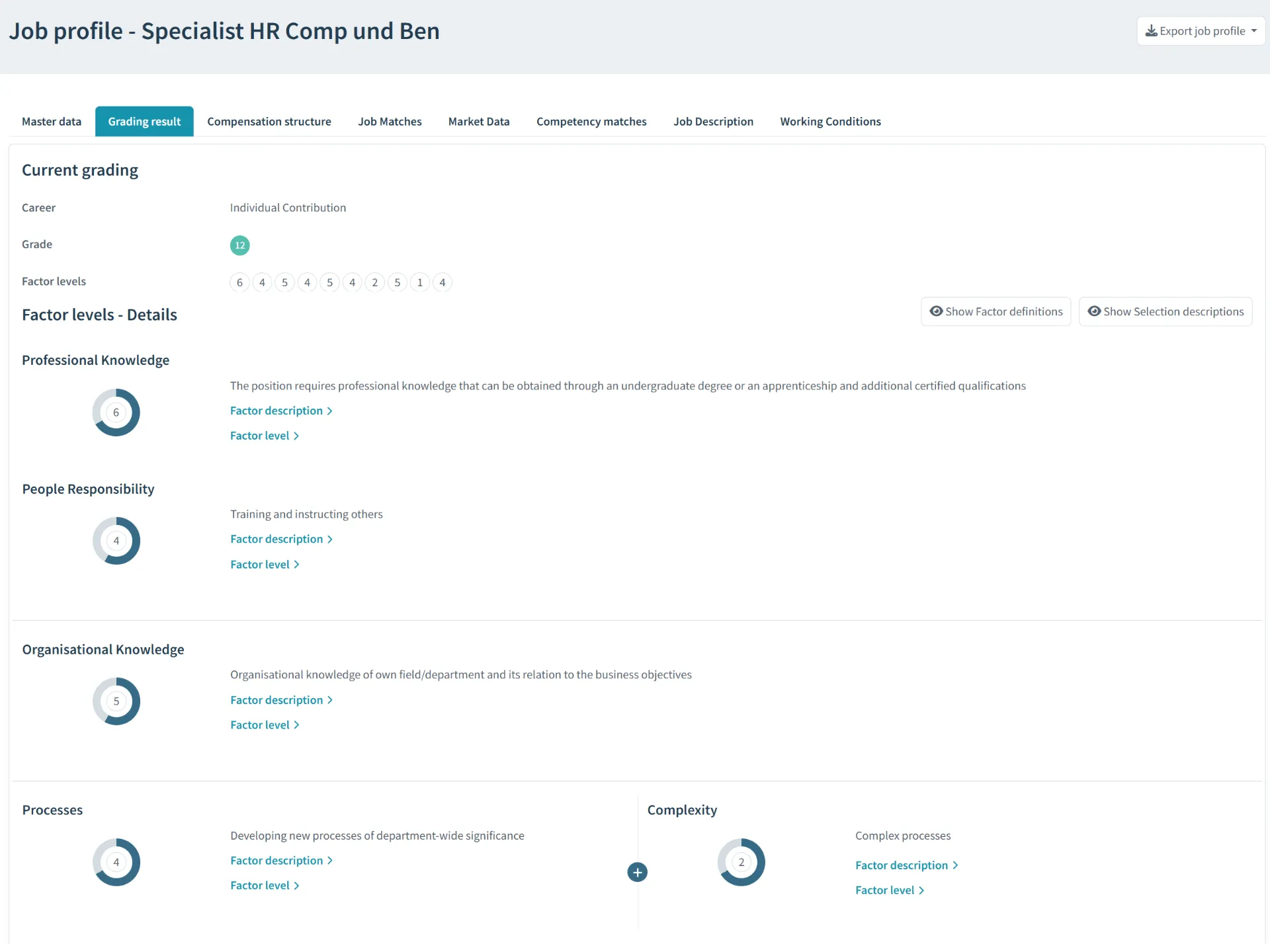
Each factor (for example: knowledge, problem solving, responsibility) is defined with clear level descriptions. Evaluators select the level that best matches the job’s requirements. Points are totalled and translated into a grade or pay band.
The point-factor method is used across all sectors and organisation sizes. It is the standard approach for organisations subject to equal pay legislation, pay transparency requirements, or cross-organisational benchmarking. Its main strength is its objectivity and auditability; its main challenge is the time required for initial design and calibration.
How it works, its advantages and key considerations:
Job classification matches roles to predefined classes or grades based on broad descriptions. The grade structure is defined first; jobs are then slotted into the most appropriate class.
A set of grade definitions is established - for example: Grade A covers routine tasks with close supervision; Grade B covers independent tasks with moderate complexity. Each job is assessed and assigned to the best-fitting grade.
Job classification is widely used in collective labour agreements, salary benchmarks and often in public sector and civil service organisations with relatively homogeneous job populations. It is faster to implement than analytical methods but introduces subjectivity at the point of classification and is difficult to apply consistently across diverse job families.
How it works, where it is used and its limitations:
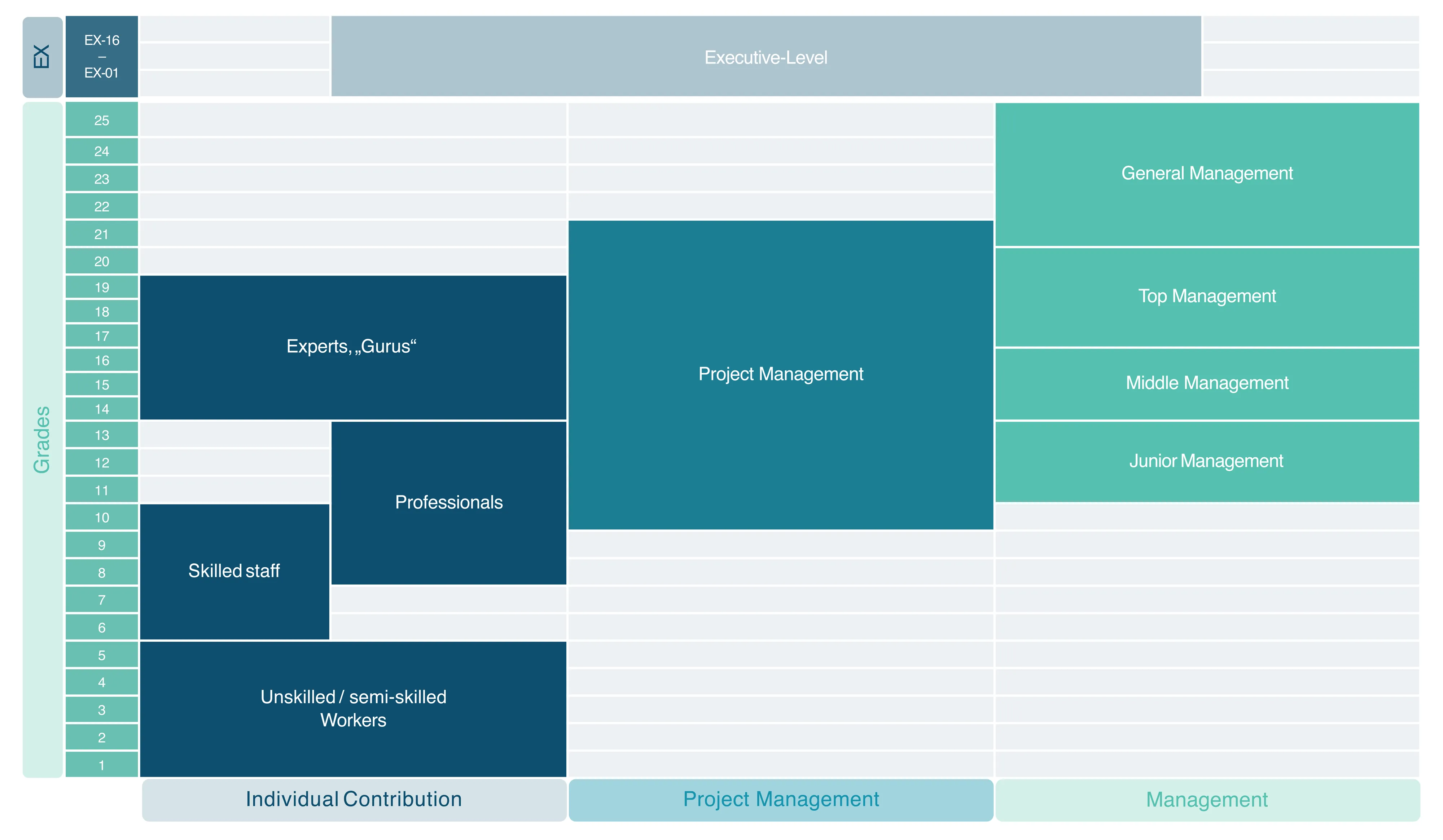
Job grading is the practical application of point-factor evaluation. It combines analytical scoring with a defined grade structure - the grade map - which forms the basis for job architecture, career paths, and compensation bands.
The terms job grading and job evaluation are often used interchangeably. In practice, job grading refers specifically to systems where the point-factor result is mapped to a fixed grade structure, giving each role a grade that reflects its relative value across the organisation.
Job grading is the most common form of analytical job evaluation in modern organisations. It supports career path design, competency mapping, pay transparency reporting, and compensation structuring - making it the most versatile of the four methods.
How it works, its structure and what to look for in a system:
Method
Job Ranking
Job Classification
Point-Factor Method
Job Grading
Analytical?
No
No
Yes
Yes
Scalable?
Low
Medium
High
High
Equal Pay Defensible?
No
Limited
Yes
Yes
Best Suited For
Very small organisations
Public sector, homogeneous populations
All sectors, equal pay compliance, benchmarking
All organisations, career architecture, pay transparency
The right method depends on your organisation’s size, structure, and objectives. The following questions help narrow the choice:
Non-analytical methods may be sufficient for organisations with fewer than 50 employees and a small number of distinct roles. Analytical methods are recommended for larger or more complex organisations.
The EU Pay Transparency Directive requires organisations to use gender-neutral, analytical job evaluation criteria covering skills, responsibilities, effort, and working conditions. Non-analytical methods do not often meet this requirement.
Only analytical systems produce the documented, auditable results required to demonstrate equal pay for work of equal value in legal or regulatory proceedings.
A point-factor or job grading system provides the consistent grade structure needed to design meaningful career ladders and job architectures.
Analytical systems produce results that can be matched to compensation survey levels and functional job codes - enabling structured, defensible benchmarking.
If you want HR to operate the system without ongoing consultant support, look for a system with clear, verbal factor descriptions, an intuitive interface, and transparent documentation.

If you are evaluating job grading systems and want to understand how a modern, web-based approach works, gradar offers a free trial with no setup required.
Job evaluation
Compensation
Pay transparency