Thank you! Your submission has been received!
Oops! Something went wrong while submitting the form.

gradar is an analytical, requirements-based job evaluation system - designed to be transparent, fair, and independently operable by HR professionals. It delivers consistent, objective results across all job levels, career paths, industries, and organisation sizes.
No black boxes. No consultant dependency. No bias.
gradar was developed from scratch to be practical, comprehensible, and free of gender or age discrimination. Four principles shape the entire methodology:
Requirements-based. Every factor is assessed against the formal requirements of the job at 100% standard performance. Performance, seniority, and perceived importance play no role.
Qualitative and transparent. Clear, verbal level descriptions replace numeric point tables. The evaluation is comprehensible to HR, managers, employees, and works councils - without external interpretation.
Non-discriminatory by design. Physical strength and revenue are excluded. Specialist career paths are valued equally to management careers. The system is compatible with equal pay legislation across multiple jurisdictions.
Modular and scalable. From SMEs to global enterprises, gradar adapts to any organisational structure - without compromising the integrity of the evaluation logic.
The gradar factor structure is grounded in established organisational theory. Every job is assessed from four perspectives:
Input - What the job holder must bring: professional knowledge and experience.
Throughput - What the job holder executes and influences: problem solving, process responsibility, organisational knowledge.
Output - What results the job is accountable for: functional, organisational, or project-related responsibility and scope of decisions.
Communication - How the job interacts with others: people responsibility, communication requirements, and social interaction.
This four-dimensional framework ensures that specialist, project, and management roles are assessed with equal rigour - and that no single dimension dominates the result.
The EU Pay Transparency Directive requires organisations to use gender-neutral job evaluation criteria grounded in four defined categories: skills, responsibilities, effort, and working conditions. gradar’s factor structure maps directly to all four:
EU Categories
Individual Contribution
Project Management
People Management
Skills
Professional Knowledge
Experience
Thinking and Cognitive Requirements / Problem Solving
Responsibility
People Responsibility
Project Responsibility & Leadership Span
Leadership Span & Guided Group of Employees
(Social) Skills
Organisational Knowledge
Responsibility
Processes & Complexity
Functional Responsibility & Scope of Decisions
Project Size & Project Budget
Processes & Complexity
Organisational Responsibility & Scope of Decisions
Social Skills
Communication
Effort
Mental and Psycho-Social Effort
Physical Effort
Working Conditions
Environmental Influences
Other Stress Factors of a Physical, Psychological or Emotional Nature
Organisations using gradar already have the methodological foundation required to demonstrate compliance with the Directive’s job evaluation requirements - without additional tooling or consultant intervention.
gradar evaluates jobs across three career paths - plus a dedicated Executive Level. The path is selected based on the core nature of the position, not the job title or reporting line.
Positions that create value through professional expertise and skill application, without disciplinary leadership - from unskilled workers to strategic subject-matter experts and technical gurus.
Factors:
Professional Knowledge
Experience
Cognitive Abilities / Problem Solving
People Responsibility
Organisational Knowledge
Processes & Complexity
Functional Responsibility & Scope of Decisions
Communication
Positions whose core objective is managing time-limited projects - coordinating people, resources, budgets, and timelines. The grade reflects the scale and complexity of the projects managed.
Factors:
Project Responsibility & Leadership Span
Project Size & Budget
Processes & Complexity
Positions with disciplinary responsibility for employees and organisational units, including budget accountability. Impact is achieved indirectly through leadership, motivation, and development.
Factors:
Leadership Span & Guided Group of Employees
Organisational Responsibility & Geographical Scope
Processes & Complexity
Scope of Decisions
Positions with overall organisational or business unit responsibility - C-level functions, managing directors, business unit heads. Evaluated across 16 executive levels (EX-01 to EX-16).
The result of a gradar evaluation is a grade from 1 to 25, or an Executive Level from EX-01 to EX-16. Jobs with comparable requirement profiles receive the same grade - regardless of career path. A specialist at Grade 18 and a manager at Grade 18 have equivalent job value.
The grade maps spans the full workforce: from unskilled and semi-skilled workers (Grades 1–5), through skilled staff and junior professionals (6–10), senior professionals and entry level management (11–13), subject matter experts and middle management (14–16), most senior experts and top management (17–22), general management (23–25), and executive leadership (EX-01 to EX-16).
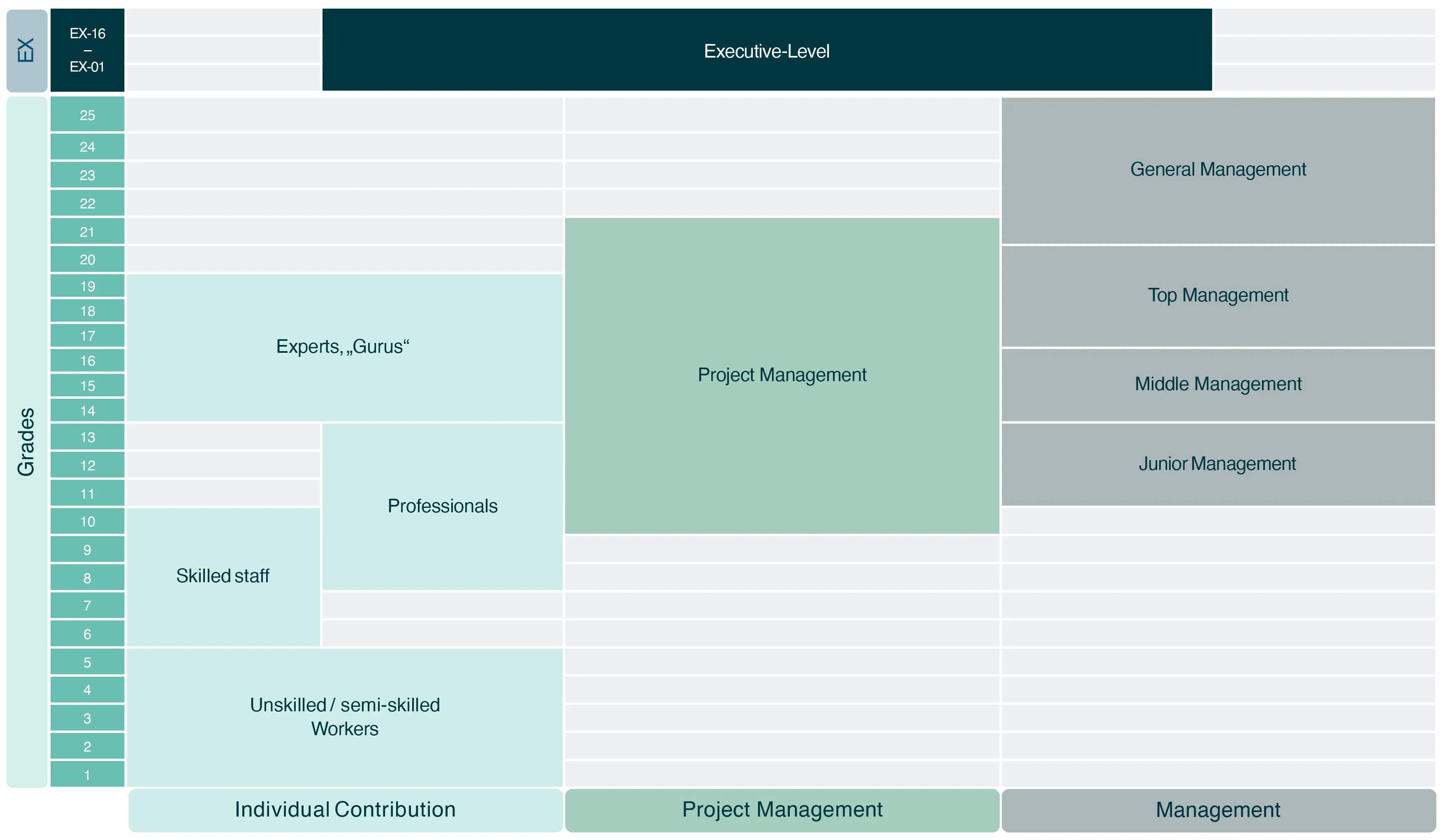
Job requirements and working conditions are two distinct things - and gradar treats them that way.
In addition to the job grade, gradar offers an optional Working Conditions module that assesses the physical and environmental burden of a role independently from its requirements. Each position receives a working conditions level from A to E:
A - No special burden
B - Low burden
C - Medium burden
D - High burden
E - Extreme burden
The result is a combined grade - for example, 10A, 10B, or 10C - that captures both the job's requirement profile and its working environment in a single, transparent classification.
This separation matters in practice. Consider two warehouse workers in the same role: one operates in a standard environment, the other in cold storage. Their job requirements are identical - same grade. But their working conditions are not. With gradar, the cold-storage worker can receive a defined working conditions allowance - a percentage or fixed amount on top of their pay range - for as long as those conditions apply. If they move to a standard environment, the allowance no longer applies. No renegotiation required. The logic is built into the structure.
The Working Conditions module uses a general assessment model designed to record remuneration-relevant working conditions and support structured allowance decisions. It is not a substitute for a detailed occupational health risk assessment - but it provides the documentation and consistency needed to manage working condition-based pay fairly and transparently.
The module is available in all paid licences and can be activated by a gradar admin on request. Organisations can also configure a company-specific model with their own factors and levels - for example, to align with collective agreements or sector-specific requirements.
Once activated, the working conditions overview provides a full list of assessed jobs, with filter options (e.g., completed vs. not yet assessed), bulk assignment via templates, and export to Excel or CSV. Templates can be created, duplicated, edited, and tracked via a built-in history - so changes are always documented.
Several factors common in older systems are deliberately excluded. Each exclusion is a methodological choice:
Revenue and business impact. Revenue fluctuates with market conditions, not job requirements. Business impact is already captured through knowledge, problem solving, responsibility, and decision-making scope.
Physical strength. No longer appropriate in a non-discriminatory framework. Where physical demands exist, they are addressed through the assessment of working conditions.
Individual performance. Performance evaluation belongs in a separate process. Conflating the two undermines the objectivity of both.
Organisational scope and turnover. Excluding company size for non-executive roles ensures comparable results across business units, geographies, and organisations - making gradar suitable for cross-organisational benchmarking.
Try the system for free - evaluate your first jobs, explore the cross comparison, and see how analytical job grading works without consultant support.
Job evaluation
Compensation
Pay transparency